
There is no one fixed definition of dyslexia. However, those working in the field of specific learning difficulties generallt recognise and agree that the following definitions help to explain the condition:-
The Delphi definition
The Delphi definition characterises dyslexia as a learning difficulty primarily affecting accurate, fluent word reading and spelling, with core challenges in phonological awareness, verbal memory, and processing speed. It emphasizes that dyslexia operates on a continuum across the full range of intellectual abilities, rather than being a distinct category, and notes that while co-occurring difficulties in areas such as motor coordination or organization may exist, they are not primary markers of the condition.emphasizes that dyslexia operates on a continuum across the full range of intellectual abilities, rather than being a distinct category, and notes that while co-occurring difficulties in areas such as motor coordination or organisation may exist, they are not primary markers of the condition.
The British Dyslexia Association definition
The British Dyslexia Association (BDA) defines dyslexia as a lifelong, neurological Specific Learning Difficulty (SpLD). It primarily affects the skills needed for accurate and fluent word reading and spelling, and is often characterized by difficulties in phonological processing, working memory, and processing speed.
The BDA’s comprehensive definition highlights several key features:
- Processing Differences: It is a hidden disability that affects information processing—impacting how much someone can remember and the speed at which they can recall information.
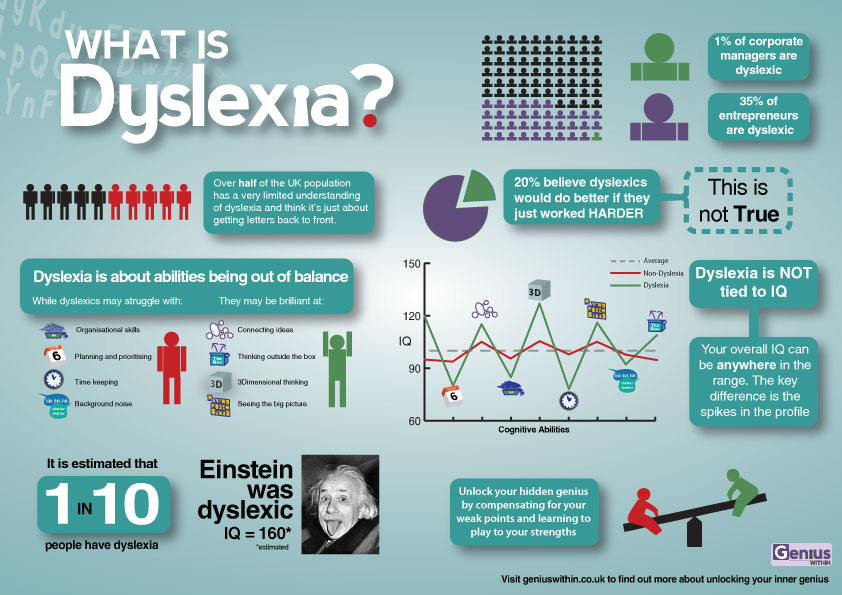
- Independent of Intelligence: Dyslexia occurs across the full range of intellectual abilities and is unrelated to a person’s general intelligence.
- A Spectrum: Dyslexia exists on a continuum, meaning its impact can range from mild to severe and varies uniquely from person to person.
- Co-occurrence: It can co-occur with other related learning differences like dyscalculia, ADHD, or developmental coordination disorder.
- Associated Strengths: The BDA emphasises that dyslexia involves both challenges and strengths; many dyslexic individuals excel in areas like reasoning, spatial design, problem-solving, and creative fields.
 Specialist Help in Education